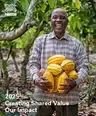

We are helping to close the living income gap for cocoa-farming communities

Our Nestlé income accelerator program for cocoa-farming families has successfully completed its 'test at scale' phase.
Cocoa-farming communities face immense challenges, from rural poverty and increasing climate risks to a lack of access to financial services and basic infrastructure, such as water, healthcare and education.
These factors can lead to social issues, including the prevalence of child labor risk on family farms. By helping families close the gap to a living income, the program aims to tackle child labor risks as well as other poverty-driven social issues. The income accelerator program is an important component of living income action plan (pdf, 2Mb), one of our 10 salient human rights issues.
Key terms explained
Living income
'Living income' defines the net income a household needs to earn in order to enable all members of the household to afford a dignified and decent standard of living, including basic needs (food, water, housing, education, health care, transportation, clothing, other essential needs and a provision for unexpected events). Read more about living income.
Living income
'Living income' defines the net income a household needs to earn in order to enable all members of the household to afford a dignified and decent standard of living, including basic needs (food, water, housing, education, health care, transportation, clothing, other essential needs and a provision for unexpected events). Read more about living income.

Our income accelerator program aiming toward 160 000 cocoa-farming families by 2030
2020
2022
2024
2030
Helping cocoa-farming families achieve a living income
Our income accelerator program aims to improve the livelihoods of cocoa-farming famil ies. It rewards cocoa farming families not just for the quantity and quality of their cocoa beans, but also for practices that benefit the environment and local community. The program’s approach aims to deliver a long-lasting impact by incentivizing the enrollment of children in school while advancing regenerative agriculture practices and gender equality. The program rewards practices that increase crop productivity and help secure additional sources of income, which aim to help close the gap in living income and help protect children.

The practices that we incentivize, through cash payments, are:
- School enrollment for all children in the household ages 6-16
- Implementing good agricultural practices, such as pruning, which increase crop productivity
- Performing agroforestry activities to increase climate resilience, like planting shade trees
- Generating diversified incomes, for example through growing other crops; raising livestock such as chickens, beekeeping, or selling vegetables from community-led gardens
These incentives are on top of the premiums offered to farmers for certified cocoa. During 2024, the income accelerator program expanded beyond Côte d'Ivoire to Ghana, with the ambition of enabling better practices for 160 000 families by 2030.
Key terms explained
Regenerative agriculture
In line with the Sustainable Agriculture Initiative Platform, Nestlé defines regenerative agriculture as an approach to farming which aims to conserve and restore natural resources, primarily soil, as well as water and biodiversity, while capturing carbon in soils and plant biomass, and to support farmers’ livelihoods. Examples of regenerative agriculture practices include reduced tillage and agroforestry. More information is available in our Nestlé Agriculture Framework (pdf, 19Mb). Read more about regenerative agriculture.
Regenerative agriculture
In line with the Sustainable Agriculture Initiative Platform, Nestlé defines regenerative agriculture as an approach to farming which aims to conserve and restore natural resources, primarily soil, as well as water and biodiversity, while capturing carbon in soils and plant biomass, and to support farmers’ livelihoods. Examples of regenerative agriculture practices include reduced tillage and agroforestry. More information is available in our Nestlé Agriculture Framework (pdf, 19Mb). Read more about regenerative agriculture.
Building on the learnings of the Nestlé Cocoa Plan
Our income accelerator program builds on the work we have been doing for more than a decade to improve the livelihoods of smallholder farmers in our cocoa supply chains, through the Nestlé Cocoa Plan. What we have learned from this program informs our current approach, focusing on initiatives already proven to positively impact farming families and reduce child labor risks.
Results from the test at scale phase are encouraging
The latest independent evaluation by the KIT Institute shows strong progress among cocoa farming households in Côte d'Ivoire:
- +4% cocoa yields, compared with a –16% decline in the comparison group
- +190% increase in cocoa net income since 2022 (vs. +100% in the control group)
- +31 percentage points higher cocoa net income even when using constant cocoa prices
- +500 kg of cocoa per household on average in the 2024/25 season
- Significant improvements in women's empowerment, savings and food security
These results confirm that the programs integrated approach - combining farm support, household support and conditional cash transfers - is helping improve productivity, income and resilience. While cocoa income has increased substantially, overall household income remains more mixed, highlighting the importance of continued efforts on income diversification.

Direct cash incentives to grow income substantially
During the first two years, cocoa-farming families can earn up to CHF 500 in direct bonus payments annually by taking part in the program and reaching the associated targets. As farmers' incomes increase from additional sources and better yields, the cash incentive is reduced to CHF 250.
The income accelerator program pays cash incentives directly to farmers, via secure mobile transfer. The cash incentive is split equally between the male and female head of household to encourage gender equality, share financial responsibilities, and build more resilient households.
Opportunities for improvement
During the test at scale phase, we encountered some issues with setting up mobile money accounts which delayed some payments. We are now engaging the services of a mobile money company to make sign-up and notification of incoming payments simpler and easier for farming families.
Collaboration is crucial
Our program would not be possible without the support and input of our longstanding partners. Alongside IDH (The Sustainable Trade Initiative), ICI (International Cocoa Initiative), the Rainforest Alliance, governments, suppliers, cooperatives and farmers, we will continuously measure, assess and strengthen the program to deliver maximum impact for farming families.
Increased traceability and transparency
At the same time, we are remodeling our sourcing to segregate and trace all our cocoa products from origin to factory. This will drive greater supply chain transparency and accountability, while giving our consumers more visibility in to where our ingredients come from.